PropTech · Singapore
AI systems for Singapore real estate agencies
The kaysera Portal runs an agency's week from the ad to the conversation. Every lead in one place, with who owns it and where it stands. Every campaign scored on what each signup cost. And the calculators and client decks that turn a visitor into a client, built to Singapore's rules.
Christian Oh, a property agent with JNA Investments, a team under JNA Real Estate. His own brand, REDEMPTION, runs its calculators and client decks on kaysera. Read how.
§ 01
Runs at REDEMPTION, Christian Oh's own brand.
REDEMPTION is the first partner on kaysera. What it runs, counted on its own public site, and a week of its ads, scored in Campaign Manager.
What REDEMPTION runs
- 15
- calculators on one shared engine, one open to everyone
- 4
- regulators' rules encoded and dated: IRAS, MAS, CPF, HDB
- Nightly
- the published benchmark rate read again, so no page carries a stale figure
Counted on the calculator index at redemption.sg/tools, which names all four regulators and the fifteen. Checked 9 September 2026.
The September push, scored
- 1,922
- people reached the page
- 6
- people signed up for the webinar
- S$175.62
- for each signup, if every signup came from the ads
From the Campaign Manager scorecard of REDEMPTION's September push: a week of ads for a webinar, 11 to 17 September 2026. Checked 26 September 2026.
Most advisors keep the maths to themselves. I'd rather you check it yourself: one calculator open to everyone, fourteen more sent by hand when you ask.
 Christian Oh Property agent with JNA Investments, a team under JNA Real Estate On redemption.sg
§ 02
What the team stops doing by hand.
Four jobs that fill an agency's week, and what runs each of them instead.
- Leads
- By hand Signups land in a form inbox, a spreadsheet or someone's phone. Follow up depends on who saw them first.
- Instead Client Manager holds every lead, who owns it and where it stands, and emails the team when one arrives. live
- The push
- By hand Spend in the ads manager, signups somewhere else, and what each signup cost worked out by hand, if at all.
- Instead Campaign Manager scores every push: what it spent, the signups it brought and what each one cost. live
- Proposals
- By hand Excel, then screenshots, then Canva, rebuilt for every client while the rules underneath move with TDSR, ABSD and CPF.
- Instead The client's position entered once, carried through every calculation, and the deck generated from the same run. live
- Scheduling
- By hand Every viewing and meeting arranged by hand across dozens of client WhatsApp groups.
- Instead Project Ash reads the thread, flags a reply that is owed and books the agreed viewing. Being built. next
§ 03
The kaysera Portal. One loop, from the ad to the conversation.
Each app is a station on the loop and hands the next what it needs. One sign in for the whole team, at portal.kaysera.io.
The loop
- The push The agency's ads bring the traffic to the page.
- The site The agency's calculators meet the visitor and ask for the conversation.
- Client Manager Holds each lead, with its owner and where it stands.
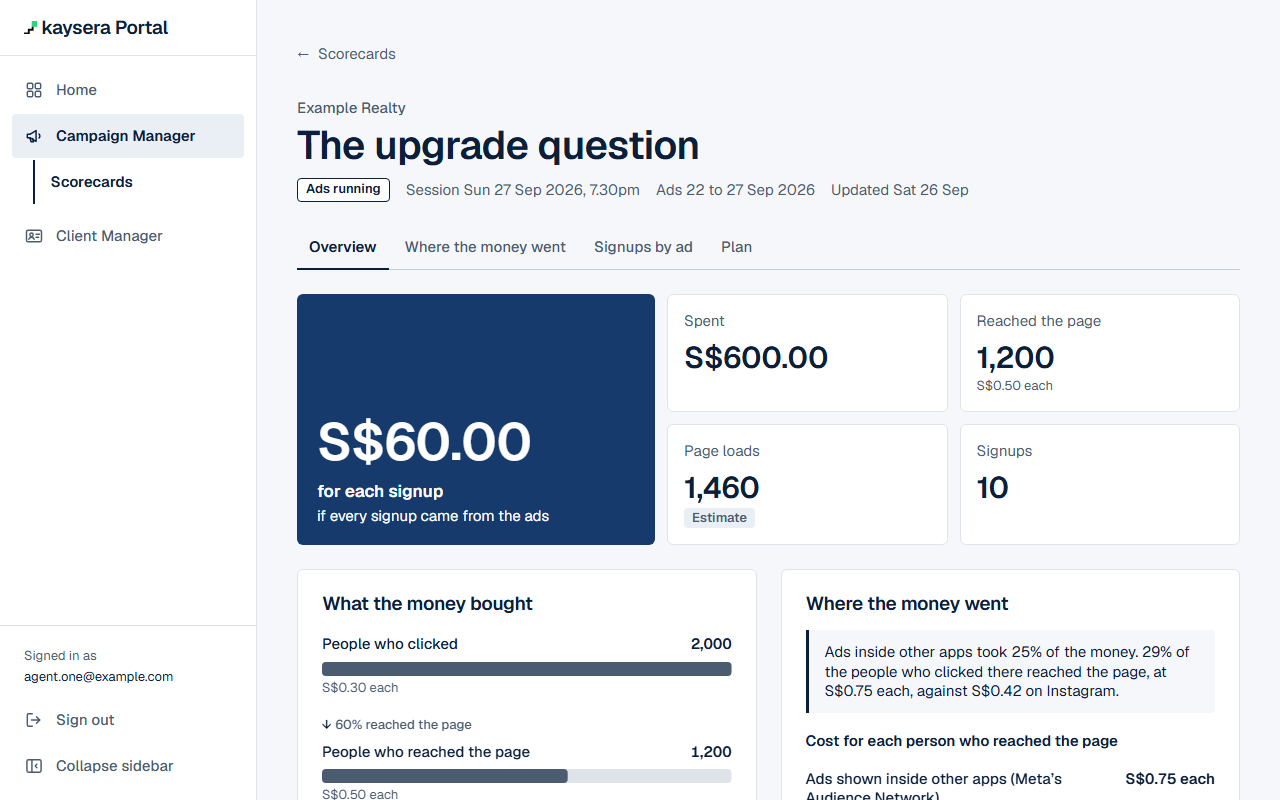
- Campaign Manager Scores the push on what each signup cost.
- Users Where kaysera sets who on the team sees what.
- Project Ash Works the client chats. Being built. next
And round again: the conversation brings the next visitor.
The apps
-
Campaign Manager live
A scorecard for every push: what it spent, the signups it brought and what each one cost.
-
Client Manager live
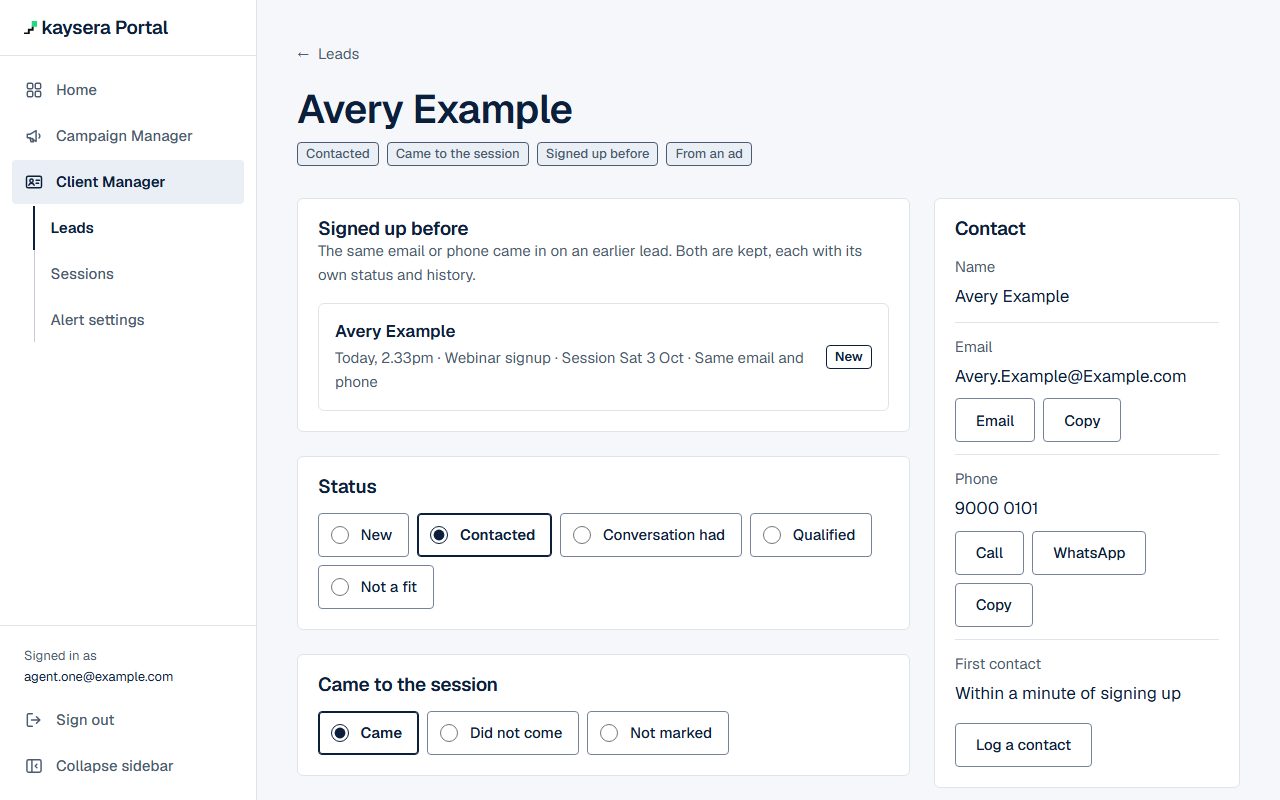
The leads that come in, and where each one stands.
-
Project Ash next
WhatsApp assistants in the client group chats an agent already runs. They read the thread, flag a reply that is owed, and book the agreed viewing into the calendar. Scheduling is the second thing on the list of what runs by hand, and this is the system that takes it.
§ 04
Built for the rules.
Singapore property runs on published rules, and so does every app in the kaysera Portal.
How it is built
- Rules are tested code
- If a regulator publishes it, it is not a prompt. Each duty band, servicing ratio and contribution rate is a function with a test and a dated citation, and when a threshold moves, the test that encoded the old one fails.
- Figures carry provenance
- A rate or a threshold is published beside its source and its as of date. A benchmark published on a schedule is read again on a schedule. A figure that cannot say where it came from does not go on the page.
- AI is kept to judgment
- The model reads what people actually send and drafts the paragraph that makes a result land. The arithmetic is deterministic, and the person whose name is on the document reviews the words.
- Leads stay in the app
- A lead arrives in Client Manager and stays there, with its status and its history, not in a spreadsheet or a chat. kaysera sets who on the team can open it.
kaysera makes software. It does not advise consumers, recommend products or handle client money, and every document belongs to the licensed professional who signs it.
§ 05
Priced by the seat. Never by the lead.
Four plans, in Singapore dollars. Paid by the year, a plan costs 10 months.
No fee per lead. Nothing tied to a sale.
kaysera charges for software, for sites and for ad work. Never for a lead, never for a deal, never as a share of a commission.
The plans
-
Agent plan
For one registered salesperson.
S$59 a month
or S$590 a year
- 1 seat
-
Team plan
For a salesperson's team.
S$390 a month
or S$3,900 a year
- 10 seats included
- S$35 a month for each seat after that
-
Division plan
For a division's teams.
S$990 a month
or S$9,900 a year
- 30 seats included
- S$29 a month for each seat after that
-
Enterprise plan
For the licensed agency.
S$25 a seat, a month
- 60 seats at least
- From S$1,500 a month
Exclusive terms for a division or an agency: ask us.
Beside any plan
A site of your own, built on the kaysera Portal and kept running.
- Your own site
- S$5,000 once
- Your agency's landing pages, up to three calculators, and forms that feed Client Manager.
- Another calculator
- S$800 each
- Past the three a site comes with.
- Platform and upkeep
- S$450 a month
- The site hosted, its content kept current and its fixes made.
- Ad push support
- S$600 a month
- Only in the months a push runs.
§ 06
Request access.
The kaysera Portal is sold to licensed Singapore agencies and the teams inside them. Write with your agency's name and how your leads arrive today, and we will walk you through the apps.
Request access Existing partner? Log in
- Web
- kaysera.io
- hello@kaysera.io
- Entity
- Kaysera LLP · Singapore
More on the company, and on what it does not do: about kaysera and the products.